Knecht Offers Himself as a Sacrifice
The Glass Bead GameKnecht Offers Himself as a Sacrifice is the turning point in Joseph Knecht’s life as the village rainmaker: when drought leaves the community facing famine and his efforts fail, he offers his own life under the village’s sacrificial custom while arranging for his son Turu to inherit the office. The act answers an immediate crisis, but it also makes the transfer of knowledge and authority part of the sacrifice’s purpose.
The Rainmaker’s Office and Its Inheritance
The decision rests on an office defined by close attention to natural cycles and communal need. The rainmaker studied the moon’s phases and effects, and each spring used inherited rules together with personal experience to determine when the village should sow. The ceremonial scattering of the first seed, however, belonged to the tribal mother or her oldest female relative, not to the rainmaker. His authority was distinct from hers, and village life placed both ritual roles within a shared seasonal order.
The rainmaker’s work became most urgent when drought or prolonged wet weather threatened crops and the community with famine. Sacrifices, exorcisms, and processions were among the measures used against such conditions. Village tradition held that, if every other means failed, the community might sacrifice the rainmaker himself. Before the crisis, Knecht had already been chosen as Turu’s apprentice and successor: the office was to pass through instruction, practice, and the apprentice’s readiness to take it up.
The Crisis and Knecht’s Decision
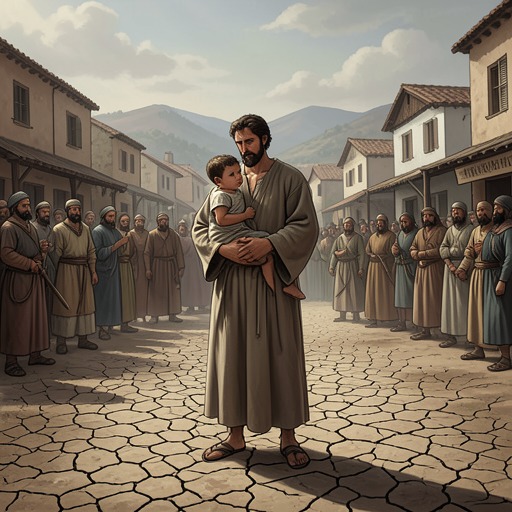
The seed-sowing ceremony took place amid great formality, but the harvest it was meant to inaugurate never followed. After a return of winter frost, spring brought erratic weather; summer crops grew thin, and a severe drought dried the smaller brooks and reduced the village pond to a muddy marsh. The villagers watched their crops wither, while occasional storms brought little relief. The failure of the season turned the rainmaker’s responsibility into a public and personal crisis.
Knecht warned his son that the situation would end badly and that it might cost him his life. He instructed Turu to assume the office if he were sacrificed, to have his body burned and his ashes scattered on the fields, and to protect the community’s seed grain through the winter. He expected the next year to be better and anticipated that villagers would see the young rainmaker as the beginning of a change. These instructions make clear that his offer was not simply a surrender to the village’s fear: it was also a succession plan intended to preserve the office and safeguard the means of future sowing.
The Offer and Its Public Meaning
Despair spread through the village. Maro stirred the people against Knecht, threats and curses were directed at the rainmaker, and Ada fell gravely ill. Processions, sacrifices, and drum choruses brought no improvement. Knecht led these rites as his duty required, but afterward he found himself shunned and knew that Maro had pressed the tribal mother to demand his sacrifice.
Rather than wait for the demand to decide both his fate and his son’s standing, Knecht dressed Turu in the ceremonial robes, took him to the tribal mother, and proposed him as successor while offering himself in sacrifice. She examined Knecht and agreed. The proposal thus joined two acts of authority: the tribal mother’s assent to the succession and Knecht’s own decision to make the customary sacrifice his final service to the village.
At the clearing Knecht had selected for the rite, he addressed the assembled villagers. He said that he had served as rainmaker for many years, that the spirits now opposed him and his work had failed, and that he had offered himself in the hope of placating them. He named his son as the new rainmaker, instructed the people to follow Turu’s directions after his death, and proposed Maro as the person to carry out the execution. The choice brought the village’s hostility into the open while leaving Knecht composed enough to state the succession and the terms he wanted observed.
Sacrifice, Succession, and Ritual Order
The episode draws together the village’s account of nature, authority, and death. The rainmaker’s understanding of the moon connected seasonal observation to the community’s planting, while tradition assigned the first sowing to the tribal mother. In drought, the office could become the focus of collective fear; the old custom of sacrificing the rainmaker offered a ritual response when appeals and other measures were believed to have failed. Knecht’s offer does not end the drought in the evidence presented here, but it does give the crisis a defined ritual form and makes the continuity of the office central to its resolution.
The planned burning of Knecht’s body and scattering of his ashes on the fields extends that logic beyond his death: Turu is to inherit both the office and the responsibility for the village’s seed grain and next season. Knecht’s sacrifice is therefore at once personal, communal, and transitional. The old rainmaker accepts the danger attached to his office, while attempting to ensure that his son enters the role under public recognition rather than merely succeeding him in private.